
What Is CIPP? (Cured-In-Place Pipe Explained)
Cured-in-Place Pipe (CIPP) is a trenchless pipe rehabilitation method used to repair damaged pipelines without excavation. Instead of digging up the pipe, technicians install a resin-saturated liner inside the existing pipe and cure it to form a new structural pipe within the old one. This process restores functionality, improves flow, and extends the lifespan of aging infrastructure with minimal disruption to surrounding areas.
Originally developed in the 1970s, CIPP has become one of the most widely used trenchless technologies worldwide. It is commonly used in municipal, commercial, and residential systems to repair sewer lines, storm drains, and other underground pipelines efficiently and cost-effectively.
What is CIPP?
At its core, CIPP is a method of creating a new pipe inside an existing damaged pipe. Rather than removing the old infrastructure, a flexible liner saturated with resin is inserted and then hardened in place.
Once cured, the liner forms a seamless, jointless pipe that:
- Seals cracks and leaks
- Restores structural integrity
- Prevents root intrusion and corrosion
- Improves flow efficiency
This approach offers several key advantages over traditional methods. Because the existing pipe remains in place, there is no need for large-scale excavation. This reduces disruption to roads, landscaping, and structures while significantly shortening project timelines.
CIPP is also highly adaptable. It can be used in pipes with bends, transitions, and varying diameters, making it suitable for complex pipeline systems that would be difficult or costly to replace through excavation.
Understanding the “Pipe Within a Pipe” Concept
CIPP works by creating a completely new pipe within the existing structure. This new liner eliminates joints, seals leaks, and restores full functionality.
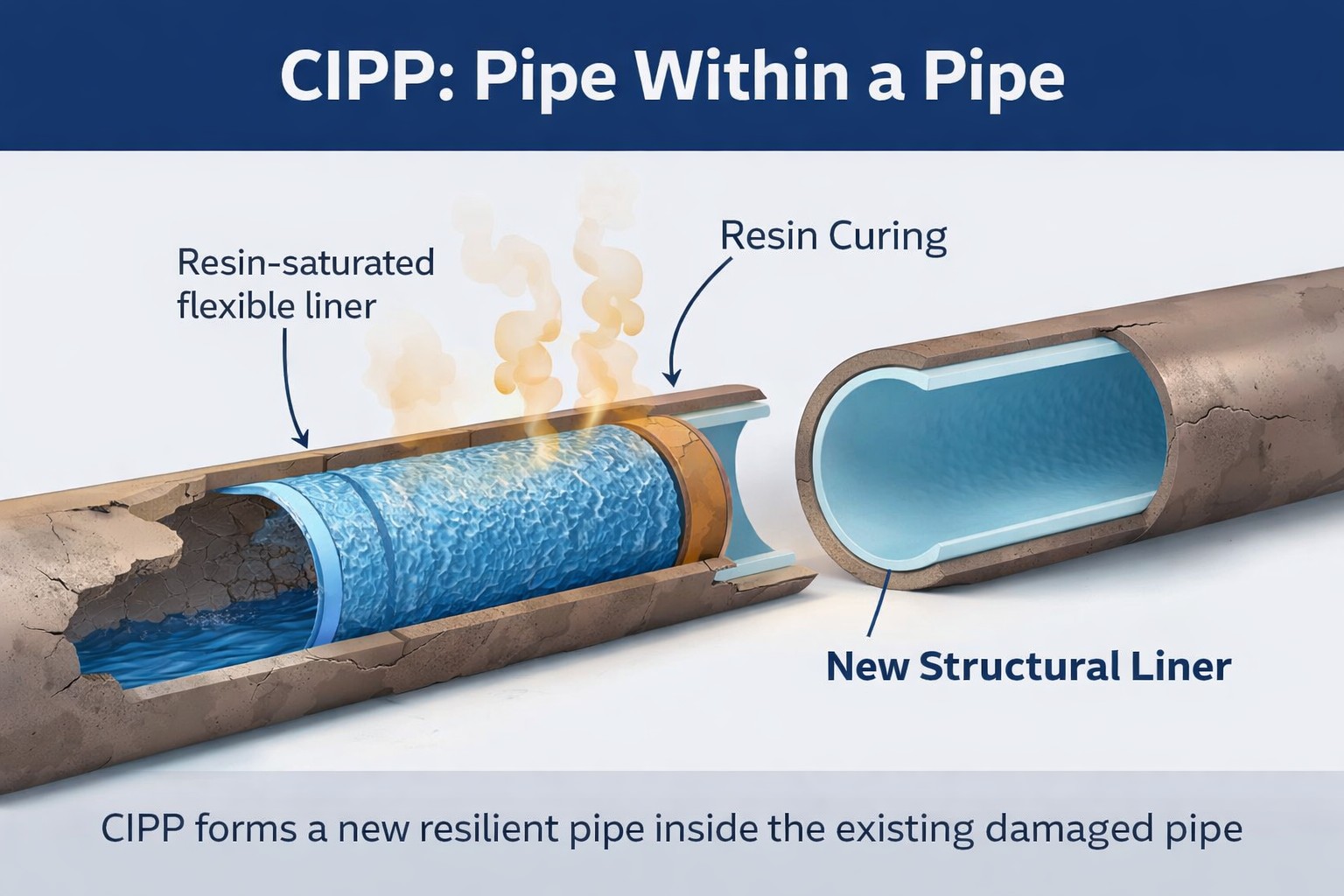
This concept allows aging infrastructure to be rehabilitated without removal, providing a modern solution to an ongoing challenge.
How CIPP Works (Step-by-Step)
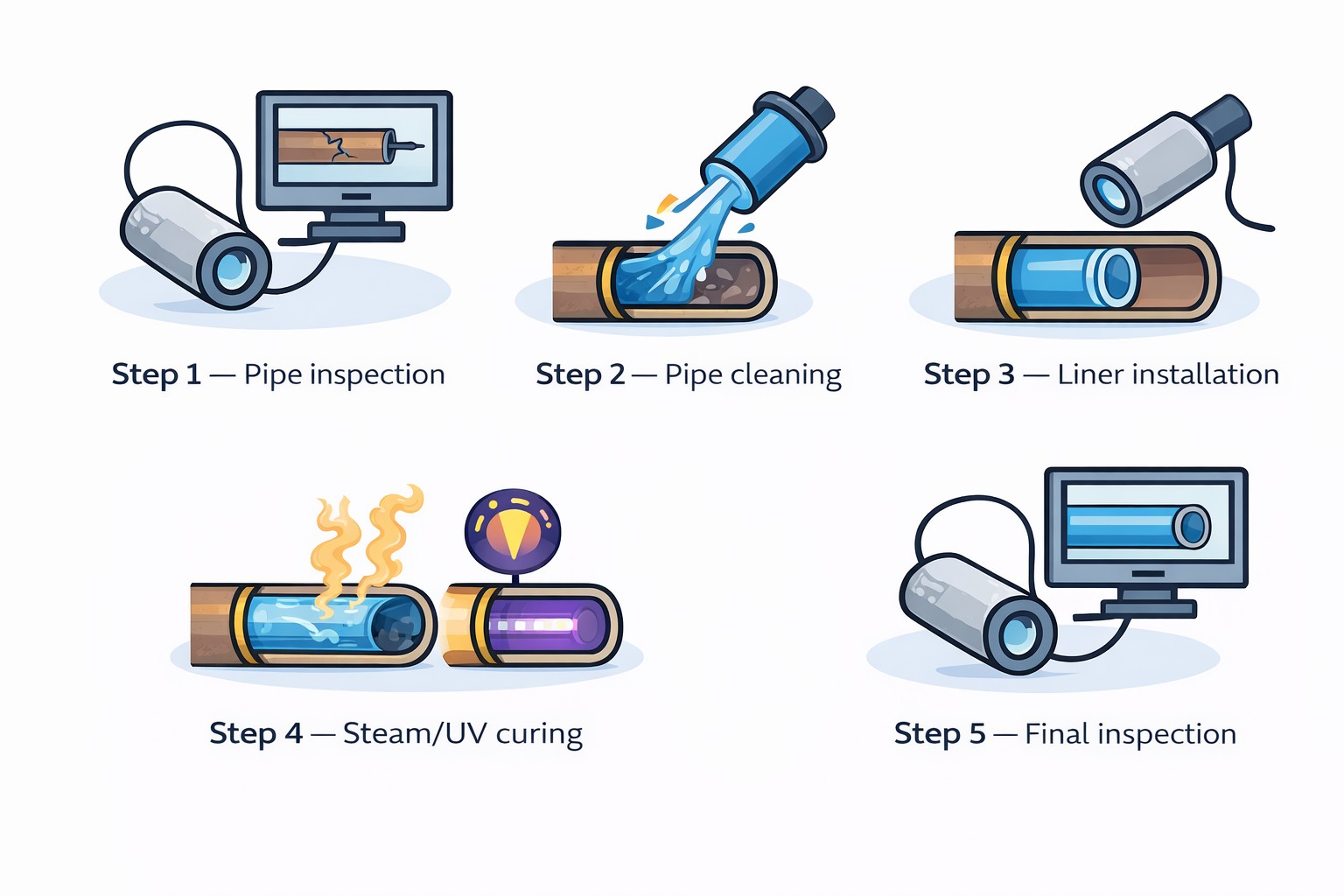
The CIPP process is carefully engineered to ensure long-term performance. Each step plays a critical role in achieving a durable and reliable result.
Step 1: Pipe Inspection
The process begins with a detailed inspection using closed-circuit television (CCTV). A camera is inserted into the pipeline to evaluate its condition. This inspection identifies cracks, corrosion, root intrusion, misalignment, and other issues.
The data collected during this stage is used to determine whether the pipe is a good candidate for CIPP and to design the appropriate liner thickness and material.
Step 2: Pipe Cleaning
Before installation, the pipe must be thoroughly cleaned. Debris, grease, scale buildup, and tree roots are removed using high-pressure water jetting or mechanical cleaning tools.
This step is essential because any remaining debris can prevent the liner from properly adhering to the pipe walls.
Step 3: Liner Preparation and Installation
The liner is saturated with a specially formulated resin and then inserted into the pipe. This can be done using inversion (where the liner is turned inside out using air or water pressure) or by pulling it into place. As the liner is installed, it conforms to the shape of the existing pipe, including any bends or irregularities.
Step 4: Curing the Liner
Once the liner is in position, it is cured using one of several methods:
- Steam curing
- Hot water curing
- UV light curing
This process activates the resin, causing it to harden and form a rigid, durable pipe within the existing structure.
Step 5: Final Inspection and Reinstatement
After curing, the pipe is inspected again using CCTV to confirm proper installation. Any service connections that were temporarily covered are reopened, and the system is returned to full operation.
Advantages of CIPP
Cured-In-Place Pipe (CIPP) has become one of the most widely adopted trenchless rehabilitation methods due to its ability to restore pipelines efficiently while minimizing disruption. Its advantages extend beyond convenience, offering long-term structural performance, adaptability, and cost savings across a wide range of applications.
Minimal Surface Disruption
One of the most significant advantages of CIPP is the ability to rehabilitate pipelines without extensive excavation. Traditional pipe replacement often requires digging trenches that can damage roads, landscaping, sidewalks, and surrounding infrastructure. CIPP eliminates most of this disruption by working within the existing pipe. This is particularly beneficial in:
- Urban environments with heavy traffic
- Residential areas where landscaping and hardscapes must be preserved
- Commercial properties where downtime needs to be minimized
By reducing surface impact, CIPP helps maintain normal operations and avoids costly restoration work after installation.
Faster Project Timelines
CIPP installations are typically completed much faster than traditional excavation methods. In many cases, projects can be completed within a single day, depending on the length and condition of the pipe.
This shorter timeline is made possible because:
- There is no need for extensive digging or site preparation
- Installation and curing can be completed in a continuous process
- Fewer labor-intensive steps are required
Faster completion not only reduces inconvenience but also limits the time that systems are out of service.
Cost Efficiency over the Full Project Lifecycle
While the upfront cost of CIPP can vary depending on project conditions, it often proves to be more cost-effective when considering the full scope of work. Traditional excavation projects involve additional expenses such as:
- Demolition and removal of existing materials
- Restoration of pavement, landscaping, and structures
- Extended labor and equipment use
- Traffic control or operational disruptions
CIPP avoids many of these costs, making it a practical solution for both small-scale and large-scale rehabilitation projects.
Structural Strength
CIPP liners are designed to restore or enhance the structural integrity of the existing pipe. Once cured, the liner forms a rigid, load-bearing structure that can withstand internal pressure and external forces.
Depending on the design, the liner can function as a fully structural pipe capable of independently supporting loads or a semi-structural reinforcement that works with the existing pipe. This flexibility allows engineers to tailor the solution based on the condition of the pipeline and the surrounding environment.
Jointless and Leak-Resistant Design
Unlike traditional pipe systems that rely on joints, CIPP creates a seamless, continuous liner. This eliminates common failure points where leaks and root intrusion often occur.
The jointless design helps:
- Prevent groundwater infiltration
- Reduce the risk of exfiltration (leaking wastewater)
- Improve overall system integrity
This is especially important in aging infrastructure where joints have deteriorated over time.
Versatility Across Pipe Types and Configurations
CIPP is highly adaptable and can be used in a variety of pipe materials, including:
- Clay
- Cast iron
- PVC
- Concrete
It is also effective in pipes with:
- Bends and curves
- Diameter transitions
- Irregular shapes
This versatility makes it suitable for complex systems where traditional replacement would be difficult or impractical.
Extended Service Life
When properly designed and installed, CIPP liners commonly have a lifespan of 50 years or more. The materials used are resistant to corrosion, chemical exposure, and environmental stress. This long service life reduces the need for future repairs and contributes to lower lifecycle costs over time.
Reduced Environmental Impact
CIPP is considered a more environmentally friendly option compared to traditional excavation methods. By avoiding large-scale digging, it reduces:
- Soil disturbance
- Construction waste
- Emissions from heavy equipment
Additionally, the ability to rehabilitate existing infrastructure helps extend the life of materials already in place, reducing the need for new resources.
Overall, the advantages of CIPP make it a practical and reliable solution for modern pipeline rehabilitation. Its combination of efficiency, durability, and adaptability has made it a preferred choice for municipalities, property owners, and engineers seeking long-term solutions with minimal disruption.
Where CIPP Is Used
CIPP is used across multiple industries and applications due to its flexibility and effectiveness.
Municipal Infrastructure
Cities and municipalities use CIPP to rehabilitate aging sewer systems, storm drains, and large-diameter pipelines. This helps extend the life of infrastructure without disrupting traffic or public services.
Commercial Properties
Commercial facilities rely on CIPP to repair underground piping systems without interrupting operations. This includes shopping centers, office buildings, and industrial sites.
Residential Systems
Homeowners benefit from CIPP for repairing sewer laterals and underground plumbing without digging up yards, driveways, or foundations.
Specialized Applications
CIPP is also used in more complex scenarios, including:
- Pipes beneath roadways or buildings
- Vertical pipe systems
- Pipelines with multiple bends or transitions
- Large-diameter pipeline systems and manholes
There are very few limitations to using CIPP. It has extensive and broad capability, which is one of the top reasons it has become a go-to solution.
CIPP vs Traditional Pipe Replacement
When comparing CIPP to traditional excavation, the differences are significant.
| Feature | CIPP | Traditional Excavation |
|---|---|---|
| Excavation | Minimal | Extensive |
| Installation Time | Hours–1 day | Several days |
| Surface Disruption | Low | High |
Traditional methods require digging trenches to remove and replace the pipe, which can damage surrounding infrastructure and increase project costs. CIPP avoids these issues by working within the existing pipe.
In addition to reduced disruption, CIPP often provides faster completion times and lower overall impact on property and operations.
CIPP vs Other Trenchless Methods
CIPP is one of several trenchless technologies used to rehabilitate or replace underground pipelines. While all trenchless methods aim to reduce excavation, they differ significantly in how they function, their level of structural support, and the types of problems they are best suited to address.
Understanding these differences is essential when determining the most appropriate solution for a specific pipeline condition.
Sliplining
Sliplining is one of the oldest trenchless rehabilitation methods. It involves inserting a new, smaller-diameter pipe into the existing pipe and sealing the annular space between the two. This is a pre-manufactured pipe inserted into the existing line. Because it is pre-manufactured, it is thicker than CIPP, which means it will reduce the internal pipe diameter. This type of trenchless method does require some additional access pits for both entry and exit points.
So, how does it compare to CIPP? CIPP has a clear advantage in maintaining the original pipe diameter. Because the liner conforms tightly to the interior walls, there is minimal loss of flow capacity. Sliplining, on the other hand, reduces the diameter, which can impact hydraulic performance, especially in systems that are already near capacity.
CIPP is also more adaptable in complex pipe systems. Sliplining is best suited for straight, uniform pipes, whereas CIPP can handle bends, transitions, and irregular shapes.
Pipe Bursting
Pipe bursting is a trenchless replacement method rather than a rehabilitation technique. It involves breaking apart the existing pipe while simultaneously pulling a new pipe into place.
In this scenario, the existing pipe is fractured outward and into the surrounding soil of the line. A new pipe is run through and installed in its place. The tool simultaneously pulls in the new line while bursting the old one. This again will require access pits, as well as sufficient space surrounding the pipeline for the bursting process.
In comparison to CIPP, the primary difference is that pipe bursting replaces the pipe entirely, while CIPP rehabilitates the existing structure. Pipe bursting can be beneficial when the original pipe is severely deteriorated or collapsed beyond repair.
However, pipe bursting is generally more invasive than CIPP. It requires more space, involves ground displacement, and can pose risks to nearby utilities or structures if not carefully managed. CIPP, by contrast, is less disruptive and better suited for pipes that are still structurally intact but need reinforcement or sealing. It also avoids the risks associated with expanding the pipe outward during installation.
Spray-in-Place Pipe (SIPP)
Spray-in-Place Pipe (SIPP) involves applying a coating, typically epoxy or cementitious materials, to the interior surface of a pipe. This method is often used for corrosion protection or minor rehabilitation.
This is a sprayed coating that will be applied in layers to achieve the necessary effect. It’s typically non-structural or just semi-structural, but it is still strong and durable when applied. This is popular for many large-diameter lines that have plenty of space to move through with the spraying equipment. Think of storm drains and substantial municipal lines. It can also be useful in vertical systems and some smaller lines.
CIPP provides a fully structural solution, meaning it can restore the pipe’s ability to handle loads independently. SIPP, in most cases, does not offer the same level of structural reinforcement and is better suited for sealing or protecting pipes rather than rebuilding them.
Choosing the Right Method
No single trenchless method is ideal for every situation. The appropriate solution depends on several factors, including:
- The condition of the existing pipe
- Whether the pipe is structurally intact or collapsed
- Pipe diameter and length
- Soil conditions and surrounding infrastructure
- Access limitations
- Budget and project timeline
CIPP is often preferred when the goal is to restore structural integrity while minimizing disruption. Its ability to create a seamless, jointless pipe within the existing system makes it one of the most versatile and widely used trenchless technologies.
However, in cases where the pipe is beyond repair or where diameter changes are required, alternative methods such as pipe bursting or sliplining may be more appropriate.
How Much Does CIPP Cost?
CIPP costs can vary depending on several project-specific factors. While exact pricing depends on conditions, understanding these variables helps set realistic expectations. In general, CIPP installation may range anywhere from $80 to $250+ per linear foot for smaller residential or commercial pipes, while larger municipal or specialty projects can exceed that range due to increased complexity and engineering requirements.
Because every project is unique, costs are influenced by pipe size, access, condition, and installation method. For this reason, most projects require an inspection and evaluation before an accurate estimate can be provided.
Factors That Affect Cost
There are many different variables that will impact cost. Things such as location, accessibility, materials, and other elements can increase costs. Hiring a professional to inspect and provide a detailed quote is the best way to get an accurate expectation of potential expenses.
These are the factors that will impact cost the most:
- Pipe diameter
- Pipe length
- Accessibility and entry points
- Existing pipe condition
- Liner material and thickness
- Curing method (steam, water, or UV)
Although initial costs may vary, CIPP often reduces total project expenses by eliminating excavation and minimizing restoration work.
CIPP Lifespan & Durability
CIPP is designed for long-term performance. When properly installed, liners commonly last 50 years or more.
The durability of CIPP comes from its seamless construction and resistance to:
- Corrosion
- Chemical exposure
- Root intrusion
- Soil movement
Engineering design plays a critical role in ensuring performance. Factors such as soil conditions, groundwater levels, and load requirements are evaluated to determine the appropriate liner specifications.
Frequently Asked Questions About CIPP
How long does CIPP last?
CIPP liners typically last 50+ years when installed according to industry standards. The longevity comes from the materials used, which are designed to resist corrosion, chemical exposure, and root intrusion. The actual lifespan can vary depending on factors such as soil conditions, groundwater levels, and how well the system is maintained over time. Proper design and installation are critical, as the liner thickness and resin type must be matched to the pipe’s environment and load requirements.
Is CIPP safe?
Yes, CIPP is widely used and considered safe when installed properly and in compliance with regulations. It has been used for decades in municipal, commercial, and residential applications and follows established industry standards, including ASTM guidelines.
During installation, trained professionals follow controlled procedures to manage materials and curing processes. Once cured, the liner forms a stable, inert pipe that is safe for wastewater and stormwater systems. As with any infrastructure process, safety depends on proper handling, certified installers, and adherence to local and industry regulations.
What types of pipes can be lined?
CIPP can be used in nearly any pipe material. This includes clay, concrete, PVC, Orangeburg, cast iron, and more. It is also effective in pipes with varying conditions, such as minor cracking, corrosion, joint separation, or root intrusion. Because the liner conforms to the shape of the existing pipe, it can be installed in systems with bends, transitions, and irregular geometries.
Can CIPP repair collapsed pipes?
CIPP is most effective for pipes that are damaged but still structurally intact. This includes pipes with cracks, leaks, corrosion, or deformation. If a pipe is fully collapsed or severely misaligned, CIPP may not be suitable without additional preparation. In some cases, spot repairs or partial excavation may be required to restore enough structural integrity for the liner to be installed.
What pipe sizes can be lined?
CIPP can be used for pipes ranging from small residential lines to large municipal systems. The general range of capability extends from as small as 3-inch pipes to as large as 120 inches in diameter. The method is highly scalable, making it suitable for everything from individual sewer laterals to major infrastructure projects. Larger diameter applications often require specialized equipment and engineering design, but the core process remains the same.
Industry Standards and Credibility
Cured-in-Place Pipe (CIPP) is not an experimental or emerging technology—it is a well-established rehabilitation method supported by decades of use, engineering validation, and standardized practices. Its reliability is reinforced by industry standards, regulatory oversight, and widespread adoption across municipal and commercial infrastructure systems.
CIPP design, materials, and installation are governed by recognized industry standards, most notably those developed by ASTM International. These standards provide detailed guidance on everything from liner composition to structural performance and testing requirements.
Commonly referenced ASTM standards for CIPP include:
- ASTM F1216 – Standard practice for rehabilitation of existing pipelines using inversion and resin curing methods
- ASTM F1743 – Standard practice for pulled-in-place CIPP installation
- ASTM D5813 – Standard specification for cured-in-place thermosetting resin sewer piping systems
These standards ensure consistency across projects because everything adheres to strict material properties and performance requirements. The installation procedures and quality control measures are highly specific, as are structural design methodologies. Professionals who are certified and compliant with these standards go above and beyond just the basics.
What is CIPP?
CIPP has become one of the most effective solutions for rehabilitating damaged pipelines. By eliminating the need for excavation, reducing disruption, and providing long-term durability, it offers a practical alternative to traditional pipe replacement.
Understanding how CIPP works, where it is used, and how it compares to other methods allows property owners and decision-makers to make informed choices about infrastructure repair.